Welcome to the first post on the Upper Danube Austria Supersite blog. We start with the biggest milestone in the history of DANUBIUS-RI so far: since June 2025, the International Centre for Advanced Studies on River-Sea Systems has been a European Research Infrastructure Consortium (ERIC).
In this post we explain what ERIC status means, who represents Austria in the new bodies, and what changes for our Supersite on the Danube and the Ybbs.
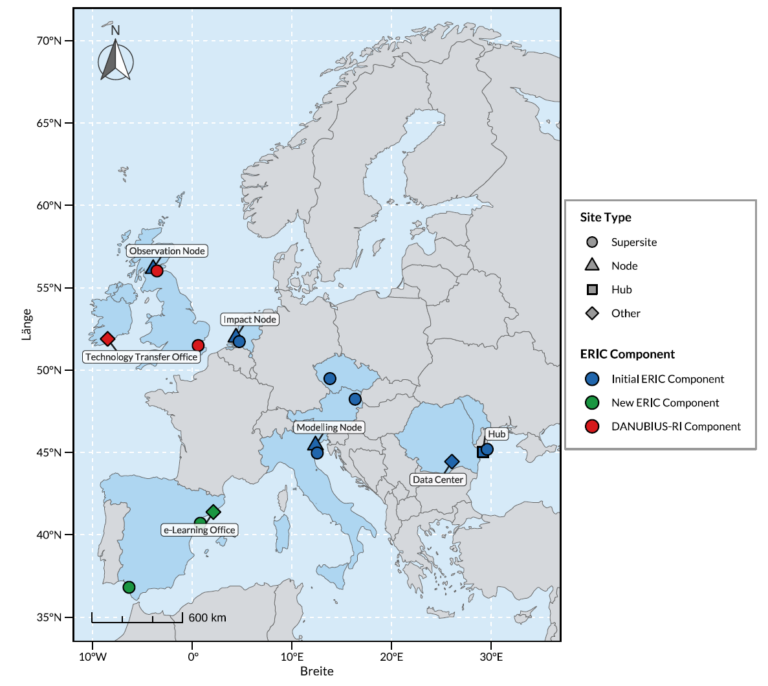
Austria is one of seven founding members, together with Czechia, Italy, Moldova, the Netherlands, Romania and the United Kingdom. Romania hosts the Hub, the central coordination centre that also houses the data centre (see the map below).
The ERIC caps a long journey. DANUBIUS-RI joined the ESFRI Roadmap in 2016 and is now an ESFRI Landmark, a status for research infrastructures that have reached an advanced stage of implementation.
BOKU and the Federal Ministry of Women, Science and Research (BMFWF) marked the milestone with a joint press release that names all Austrian partners.
Spatial overview of the DANUBIUS-ERIC components in Europe. Countries shown in blue indicate the seven founding members (Austria, Czechia, Italy, Moldova, the Netherlands, Romania, United Kingdom) and Spain (joined in 2026). Map source: Hayes et al. (2026): https://doi.org/10.1007/s00506-026-01249-w.
How DANUBIUS-ERIC is governed
As an ERIC, DANUBIUS-RI now has its own governing bodies under European law. The General Assembly (GA) replaces the former Board of Governmental Representatives (BGR), which brought together ministry representatives and technical experts.
The General Assembly is the member states‘ decision-making body, meeting twice a year.
Other bodies include the Research Infrastructure Committee (RIC) and the Scientific Advisory Committee (SAC). The RIC develops and coordinates technical equipment, data management and services, the SAC gives independent scientific advice. Marcel Liedermann and Daniel S. Hayes are Austrian RIC representatives, Christian Griebler is Austrian delegate to the SAC.
What this means for the Upper Danube Austria Supersite
The Upper Danube Austria Supersite is the freshwater component of DANUBIUS-RI. BOKU’s Institute of Hydrobiology and Aquatic Ecosystem Management (IHG) and Institute of Hydraulic Engineering and River Research (IWA) coordinate it. Eleven research partners from six institutions take part: BOKU, the University of Vienna, TU Wien, the University of Innsbruck, WasserCluster Lunz and the Environment Agency Austria.
For researchers, the ERIC makes it easier to reach facilities, data and services beyond Austria. Our results can now be compared directly with other Supersites, Nodes and the Hub along the whole river–sea continuum.